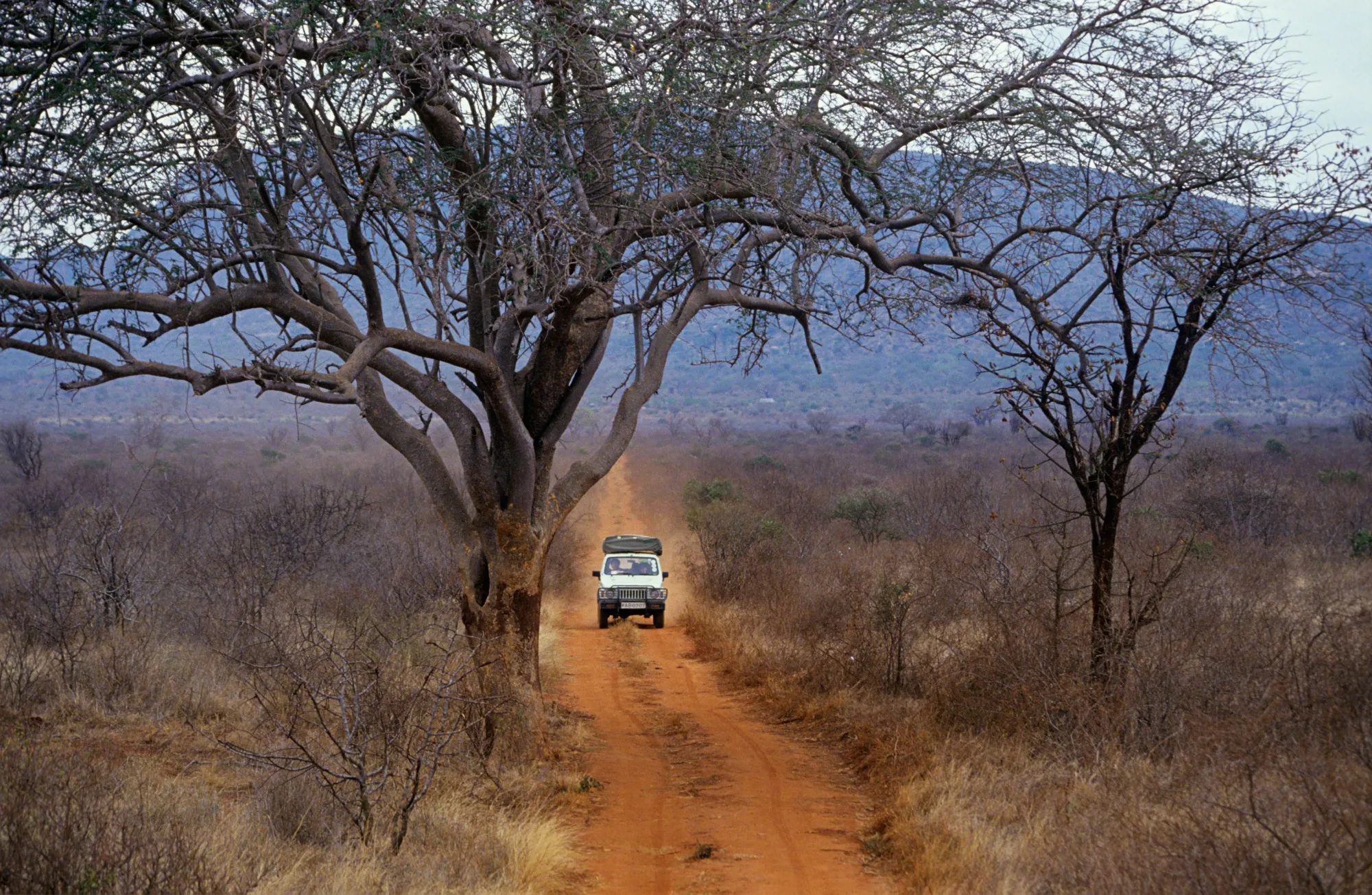
Tsavo National Parks (East & West)
Discover Tsavo East and Tsavo West, Kenya's largest national park wilderness. Famed for dust-red elephants, the ancient Yatta Plateau lava flow, underwater hippo viewing at Mzima Springs, and rugged volcanic expanses.
About Tsavo National Parks (East & West)
Immense Wilderness Scale and Geography
Together covering more than 21,000 square kilometres, Tsavo East and Tsavo West form Kenya's largest national park complex and one of the largest protected conservation landscapes in the world. Established in 1948 and bisected by the Nairobi-Mombasa highway and railway, the two parks encompass dramatically contrasting landscapes shaped by ancient tectonic faults, volcanic activity, and semi-arid river systems.
Because of its vast scale and uncrowded tracks, Tsavo offers an authentic sense of classic African wilderness exploration, where travelers can drive for hours across rugged landscapes without encountering other safari vehicles.
Tsavo East: Golden Plains and Dust-Red Elephants
Tsavo East is characterized by wide, open semi-arid savannas, baobab trees, and rich red laterite soils. The park is renowned for its iconic 'red elephants'—herds that bathe in red soil dust and mud to protect their skin from intense equatorial sun and biting insects, giving them a distinctive terracotta coloration.
Key geographical landmarks in Tsavo East include:
- The Yatta Plateau: The world's longest volcanic lava flow, stretching over 300 kilometres along the western boundary of the park, formed by molten basaltic lava eruptions from Ol Doinyo Sabuk millions of years ago.
- Lugard Falls: A series of white-water rapids carved through banded multi-colored gneiss rocks on the Galana River, where giant Nile crocodiles bask on sun-warmed granite ledges.
- Mudanda Rock: A massive natural stone water catchment stretching for over one kilometre, where wildlife gathers to drink during dry periods.
Tsavo West: Volcanic Landscapes and Mzima Springs
Tsavo West presents a striking contrast, featuring rugged volcanic hills, dense acacia scrub, and recent geological formations such as the Shetani Lava Flow—a black basalt volcanic field formed by violent local eruptions only two centuries ago.
The centerpiece of Tsavo West is Mzima Springs, where fifty million gallons of crystal-filtered water emerge daily from porous volcanic rock aquifers connected to the nearby Chyulu Hills. The springs form a verdant oasis of wild date palms and fig trees, equipped with a subterranean glass-windowed observation chamber where visitors can view submerged hippopotamuses, Nile crocodiles, and shoals of barbel fish swimming in clear spring water.
Rhino Conservation in Ngulia
Tsavo West protects the secure Ngulia Rhino Sanctuary, a fenced and heavily guarded reserve within the park that safeguards a vital breeding population of the critically endangered eastern black rhinoceros (Diceros bicornis michaeli). Driven to near-extinction by poaching in the 1970s and 1980s, black rhinos in Tsavo are gradually recovering under dedicated Kenya Wildlife Service monitoring.
Seasons, Logistics and Practical Advice
Tsavo is accessible by road from Nairobi (four to five hours) or from coastal resorts around Mombasa and Diani (two to three hours), making it an ideal safari addition to a beach holiday. The Madaraka Express standard gauge railway also connects Nairobi and Mombasa with passenger stops at Mtito Andei and Voi.
The dry seasons from June to October and January to March offer optimal wildlife viewing around waterholes and riverbanks. Summer rains in April–May and November transform the plains into lush green scrubland, attracting migratory Eurasian waterbirds.
Frequently Asked Questions
What is the difference between Tsavo East and Tsavo West?
Tsavo East is flatter, drier, and more open, offering expansive plains and red-dust elephant herds. Tsavo West is hillier and more volcanic, featuring Mzima Springs, Shetani lava flows, and denser woodland cover.
How does the underwater observatory at Mzima Springs work?
Visitors walk along a shaded nature trail accompanied by a KWS ranger to a sunken concrete viewing structure submerged in the spring, allowing underwater viewing of swimming hippos and freshwater fish.
Are both Tsavo parks suitable for self-drive safaris?
Yes. Both parks have well-maintained arterial road networks and KWS entry gates, though a high-clearance 4x4 vehicle is strongly recommended for unpaved secondary tracks.
🦍 Wildlife & Nature
🎯 Top Experiences
🧳 Travel Tips & Practical Advice
Kenya Beyond the Mara: Amboseli, Tsavo and the Indian Ocean
Kenya’s safari story extends far beyond one reserve. Follow a thoughtful route from Nairobi to Amboseli’s elephant country, the vast Tsavo ecosystem and the Indian Ocean coast.
🗺️ Tsavo National Parks (East & West) Experiences
No tours are currently listed. Request a custom journey with a verified local operator.
✨ Request a Custom Journey with a Local Operator →📍 Nearby Destinations in Kenya
ℹ️ Practical Info
Explore Tsavo National Parks (East & West)
Custom journeys crafted directly by verified in-country specialists.
Request Custom Journey →