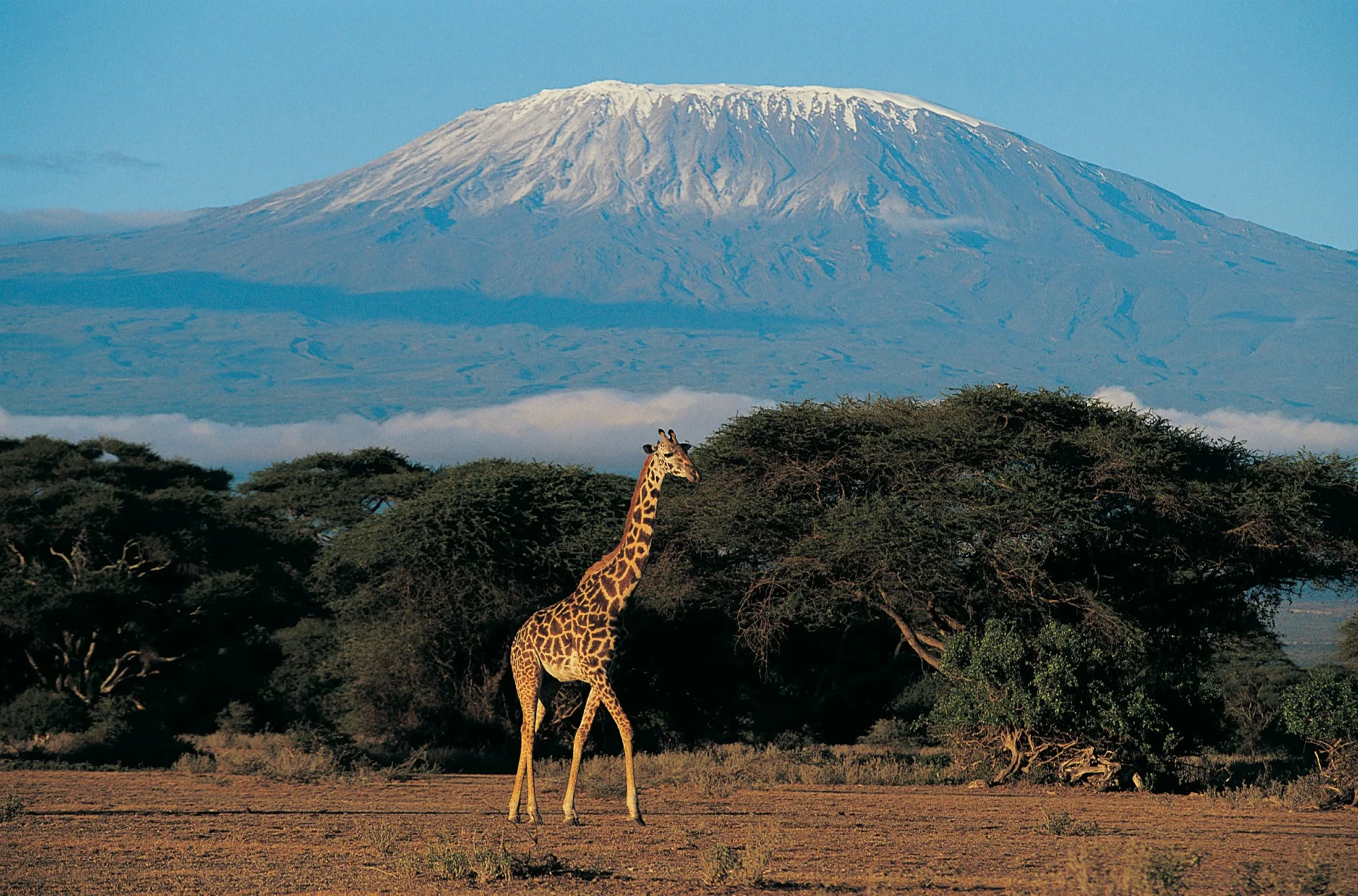
Amboseli National Park
Explore Amboseli National Park in southern Kenya, renowned for free-ranging elephant herds browsing beneath the snow-capped peak of Mount Kilimanjaro across open acacia plains and spring-fed wetlands.
About Amboseli National Park
Geographic Setting and Kilimanjaro Vistas
Amboseli National Park covers 392 square kilometres in Kajiado County, southern Kenya, nestled against the Tanzanian border. Inscribed as a UNESCO Biosphere Reserve in 1991, the park is celebrated internationally for offering one of the most distinctive photographic scenes in nature: sizable herds of free-ranging African elephants browsing peacefully against the dramatic backdrop of Mount Kilimanjaro (5,895m), the highest peak in Africa.
While the summit of Kilimanjaro lies across the border in Tanzania, Amboseli offers the continent's most panoramic views of its snow-capped dome, particularly during the early morning and late afternoon when equatorial clouds lift from the mountain.
Hydrology: The Life-Giving Springs
Despite its arid appearance and dusty Pleistocene lake bed terrain, Amboseli is sustained by an extraordinary subterranean hydrological system. Rain and melting snow from Mount Kilimanjaro percolate through porous volcanic ash layers underground, emerging in the heart of Amboseli as permanent freshwater springs at Enkongo Narok, Olokenya, and Longinye.
These permanent emerald-green swamps create fertile marsh habitats where waterbucks, hippopotamuses, Cape buffaloes, and hundreds of bird species concentrate throughout the dry season, providing a stark and vibrant contrast to the surrounding parched alkaline flats of Lake Amboseli.
Long-Term Elephant Research and Super-Tuskers
Amboseli is home to over 1,600 elephants, recognized as one of the most thoroughly studied wild elephant populations on Earth. In 1972, Dr. Cynthia Moss founded the Amboseli Elephant Research Project (AERP), which continues to monitor elephant life histories, family matriarchies, communication acoustics, and social behavior.
Because the park has maintained long-term protection, several mature bulls have survived to reach fifty or sixty years of age, carrying immense tusks that weigh over forty kilograms per side—rarely seen elsewhere on the continent. Observing these calm family herds interacting around waterholes provides profound insights into mammalian social intelligence.
Observation Hill and Ecosystem Wildlife
A central feature of the park is Observation Hill (Noomotio), a gentle volcanic pyramid formed by ancient eruptions. Visitors can disembark from vehicles to hike up stone pathways to the summit, taking in panoramic views across the entire Amboseli basin, the winding marshlands, and plains zebras and giraffes grazing below.
Predators in Amboseli include lions, spotted hyenas, cheetahs, and occasional leopards, while over 400 species of birds—such as African fish eagles, kingfishers, crowned cranes, and great white pelicans—frequent the wetland channels.
Seasons, Access and Travel Preparation
Amboseli experiences two rainy seasons (April–May and November–December). The dry months from June to October and January to February offer optimal wildlife viewing as animals gather around central swamps and road tracks remain firm. Day temperatures are typically warm (27°C to 31°C), while nights are cool.
The park is accessible by road from Nairobi (approximately four hours on paved highways via Emali) or by light charter aircraft to the Amboseli airstrip. Due to fine volcanic alkaline dust, carrying dust-proof camera bags and lens cleaning equipment is strongly recommended.
Frequently Asked Questions
Can Mount Kilimanjaro be seen clearly every day from Amboseli?
Kilimanjaro is often shrouded in clouds by mid-morning due to convective thermal rising. The clearest views occur during early dawn and late afternoon hours, particularly during dry, clear winter months.
Is walking permitted in Amboseli National Park?
Visitors must remain inside safari vehicles throughout the park, with the exception of the summit of Observation Hill, which has secure walking pathways and designated viewpoint facilities.
Are elephant sightings assured in Amboseli?
Due to the permanent freshwater springs, elephant families visit central swamps daily throughout the dry season, making sightings remarkably consistent, though movements depend on seasonal grazing availability.
🦍 Wildlife & Nature
🎯 Top Experiences
🧳 Travel Tips & Practical Advice
Kenya Beyond the Mara: Amboseli, Tsavo and the Indian Ocean
Kenya’s safari story extends far beyond one reserve. Follow a thoughtful route from Nairobi to Amboseli’s elephant country, the vast Tsavo ecosystem and the Indian Ocean coast.
🗺️ Amboseli National Park Experiences
No tours are currently listed. Request a custom journey with a verified local operator.
✨ Request a Custom Journey with a Local Operator →📷 Amboseli National Park Photo Gallery
Click any photo to enlarge (3)📍 Nearby Destinations in Kenya
ℹ️ Practical Info
Explore Amboseli National Park
Custom journeys crafted directly by verified in-country specialists.
Request Custom Journey →