Lalibela
Explore the rock-hewn monolithic churches of Lalibela in the Lasta mountains of northern Ethiopia. Chiseled from volcanic scoria in the twelfth and thirteenth centuries, these eleven medieval sanctuaries remain living places of active Orthodox Christian worship.
About Lalibela
Overview and Cultural Significance
Lalibela is situated at an elevation of roughly 2,500 metres in the rugged Lasta mountains of Amhara Region, northern Ethiopia. Recognized as a UNESCO World Heritage site in 1978, Lalibela is renowned worldwide for its eleven monolithic and semi-monolithic rock-hewn churches, carved entirely below ground level from solid red volcanic tuff during the late twelfth and early thirteenth centuries under King Gebre Mesqel Lalibela of the Zagwe dynasty.
Unlike conventional stone structures assembled with mortar and blocks, Lalibela's churches were excavated downwards into volcanic rock trenches, with columns, domes, windows, and relief carvings chiseled out of the bedrock. Conceived historically as a symbolic 'New Jerusalem' following the fall of historical Jerusalem to Saladin in 1187, the site was planned with subterranean ceremonial trenches, defensive ditches, and rock-cut drainage channels representing biblical geography, including the seasonal Jordan River.
Landscape, Architecture and Sacred Spaces
The eleven churches are arranged in two principal geographic clusters divided by the channel of the Jordan River, together with one freestanding masterpiece:
- Northern Cluster: Centered on Biete Medhane Alem (House of the Saviour of the World), recognized as the largest rock-hewn monolithic church in existence, surrounded by thirty-four external rectangular pillars. It connects via trenches to Biete Maryam (House of Mary), renowned for painted geometric carvings and early Christian frescoes, as well as Biete Maskal, Biete Danagel, and the dual sanctuary of Biete Golgotha-Mikael.
- Southeastern Cluster: Accessible through narrow ceremonial passages, featuring Biete Amanuel, finely sculpted with distinctive Aksumite stepped exterior timber-and-stone motifs; Biete Qeddus Mercoreus; Biete Abba Libanos, built into a sheer cliff face; and Biete Gabriel-Rufael, which served administrative as well as spiritual functions.
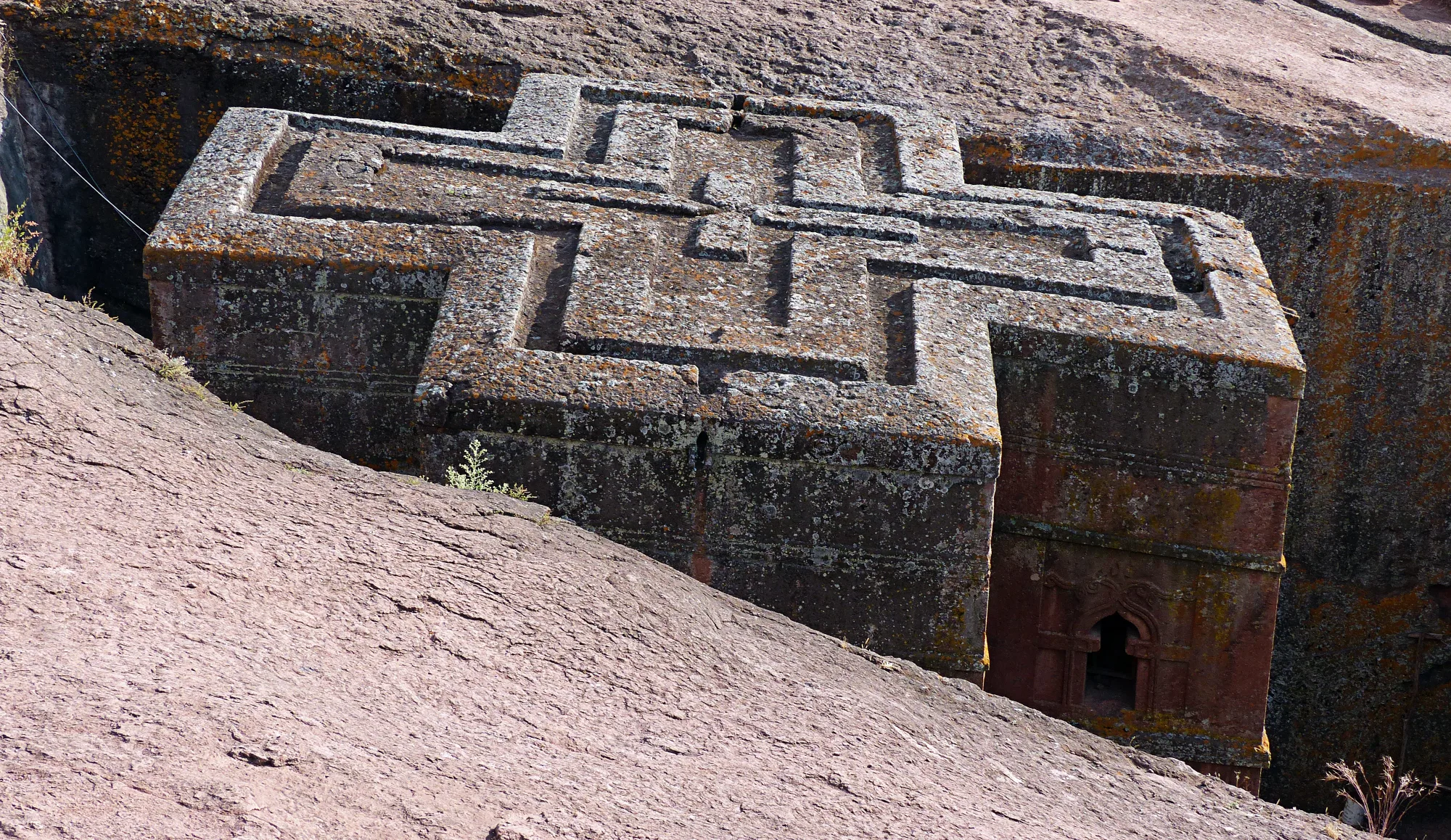
- Biete Giyorgis (Church of St. George): Located slightly south-west of the main clusters, this cruciform sanctuary sits inside a 25-metre-deep excavated rock courtyard. Its roof is carved with concentric Greek crosses that channel seasonal rainwater away from the foundation.
The architectural engineering required extraordinary geological understanding. Master masons identified structural faults in the volcanic tuff before beginning excavation, designing sloped roofs, drainage gullies, and subterranean aqueducts to channel torrential summer rainfall safely away from church foundations. This sophisticated hydraulic foresight has preserved these fragile stone structures for over eight centuries.
Living Religious Heritage and Ritual Practice
Lalibela is not an archaeological museum; it is a sacred, living center of the Ethiopian Orthodox Tewahedo Church. Daily dawn liturgies begin before sunrise with Ge'ez hymns, the rhythmic pulse of kebero prayer drums, and the gentle chime of tsenatsil sistra. White-robed deacons, priests, and hermits maintain continuous prayer vigils in cliffside cells.
During major religious festivals—most notably Genna (Ethiopian Christmas in early January) and Timkat (Epiphany shortly after)—tens of thousands of pilgrims from rural highland villages arrive on foot, singing centuries-old antiphons along the terraced slopes. Travelers who observe these services are welcome to witness the ceremonies quietly, keeping appropriate distance and observing dress codes.
The spiritual continuity here extends to monastic life in the surrounding mountains. Hermit monks inhabit small caves chiseled directly into the cliffs, devoting their lives to contemplative prayer and manuscript illumination, using natural mineral pigments ground by hand according to ancient recipes.
Seasonal Rhythms and Visiting Conditions
The highland climate around Lalibela follows distinct wet and dry seasons. The dry season runs from October through April, characterized by clear skies, warm midday temperatures (22°C to 26°C), and brisk mountain nights where temperatures can drop below 10°C. This period offers favorable trail conditions for visiting regional monasteries such as Yemrehana Krestos and Asheton Maryam.
The main rainy season (Kiremt) occurs from late June through September, bringing afternoon downpours that turn highland slopes verdant but make unpaved regional tracks muddy and occasionally slippery. Light intermittent showers may occur in March and April (Belg season). Visiting during religious holidays provides profound cultural insight but requires booking accommodation months ahead due to intense demand.
Logistics, Regional Access and Practical Details
Lalibela Airport (LLI) receives daily domestic scheduled flights from Addis Ababa, with air connections typically continuing to Gondar and Axum. Driving by road from Bahir Dar or Gondar involves traversing scenic mountain passes; road travel should always be planned with reliable private 4x4 vehicles and up-to-date regional route guidance. Within Lalibela town, moving between church clusters requires walking along uneven rock paths, stone steps, and unlit rock-cut tunnels; carrying a headlamp and wearing supportive walking shoes with good tread is essential.
Entry tickets are issued by the local church administration at the central ticket office and cover multiple consecutive days. Certified local site guides licensed by the tourism office provide essential historic and theological context.
Health, Mobility and Cultural Etiquette
At 2,500 metres altitude, travelers may experience mild breathlessness upon arrival; staying well hydrated and avoiding strenuous uphill climbs during the first day is advisable. Many church entrances involve narrow, steep steps worn smooth by centuries of pilgrims' bare feet. Shoes must be removed before entering every church interior; slip-on shoes with thick socks make transitions practical and hygienic.
Modest dress covering shoulders and knees is required at all church compounds; women traditionally wear a lightweight white cotton scarf (netela) over head and shoulders. Photography inside dimly lit sanctuaries requires permission; flash photography of ancient parchment manuscripts and wall paintings is strictly prohibited to prevent pigment degradation. Hermits and individual worshippers should not be photographed without express consent.
Frequently Asked Questions
How much time is recommended to see the churches of Lalibela?
A minimum of two full days is recommended to visit both the northern and southeastern church clusters, see Biete Giyorgis at different times of day, and take an excursion to a nearby outlying rock church such as Yemrehana Krestos.
Are the churches accessible for visitors with limited mobility?
The rock paths between churches involve uneven bedrock, stairs cut directly into stone, and dim tunnels. Visitors with mobility constraints can access several churches near level entrances, but an able-bodied companion and walking poles are strongly recommended.
What is the appropriate conduct when attending religious services?
Visitors are invited to stand quietly along church perimeters during liturgies. Shoes must be removed before stepping across church thresholds, and quiet voices should be maintained throughout sacred compounds.
🦍 Wildlife & Nature
🎯 Top Experiences
🧳 Travel Tips & Practical Advice
Ethiopia: From Ancient Highlands to the Omo Valley
Discover Ethiopia through a carefully paced, modular journey linking Addis Ababa, the Historic North, Harar, Bale Mountains, Sof Omar, the Rift Valley, Chebera Churchura, South Omo and Borana. This guide explains what makes each region distinct—and why current access must always shape the final itinerary.
🗺️ Lalibela Experiences
No tours are currently listed. Request a custom journey with a verified local operator.
✨ Request a Custom Journey with a Local Operator →📷 Lalibela Photo Gallery
Click any photo to enlarge (3)📍 Nearby Destinations in Ethiopia
ℹ️ Practical Info
Explore Lalibela
Custom journeys crafted directly by verified in-country specialists.
Request Custom Journey →