Axum Ancient Kingdom
Uncover the origins of Ethiopian civilization in Axum, the ancient capital of the Aksumite Empire in northern Ethiopia. Towering granite stelae, underground royal tombs, and sacred sanctuaries tell the story of a great commercial kingdom.
About Axum Ancient Kingdom
Historical Significance and the Aksumite Empire
Axum is located in the Tigray highlands of northern Ethiopia at an altitude of approximately 2,130 metres. As the capital of the historic Aksumite Kingdom, which thrived from the first through the eighth centuries CE, Axum was recognized by the third-century Persian philosopher Mani as one of the four great world powers of antiquity alongside Rome, Persia, and China. Inscribed as a UNESCO World Heritage site in 1980, the ruins of Axum bear testimony to advanced monument engineering, maritime commerce, and early international currency minting.
Controlling vital trade routes linking the Roman Empire, Egypt, and Nubia with the Red Sea port of Adulis, Southern Arabia, and India, Aksum was a cosmopolitan crossroads. Under King Ezana in the fourth century CE, the kingdom adopted Christianity, making Ethiopia one of the earliest Christian nations in the world.
The city developed sophisticated agrarian terraces and water harvesting systems to sustain its urban population. Trade caravans brought glassware, silk, and spices in exchange for gold, frankincense, myrrh, ivory, and agricultural produce from the Ethiopian interior.
The Monumental Stelae and Royal Tombs
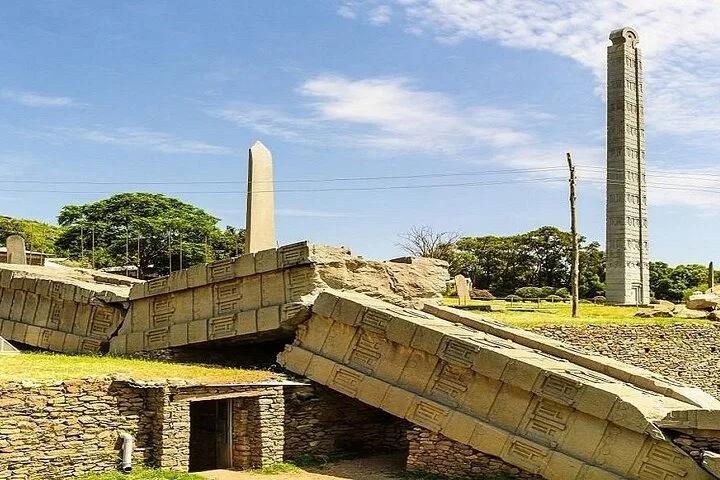
The defining visual features of Axum are its towering monolithic granite obelisks (stelae), sculpted from single blocks of blue-grey granite and erected without mortar to mark elite subterranean royal burial vaults:
- The Northern Stelae Park: Home to Stela 3 (King Ezana's Stela), which stands 24 metres tall and features intricate carvings of false multi-storey architectural windows and beam ends. Nearby lies the 160-ton Stela 2 (the Obelisk of Axum), which was looted during the Italian occupation in 1937 and returned from Rome in 2005 through collaborative conservation efforts.
- The Great Fallen Stela: Measuring 33 metres in length and weighing over 500 tons, this was the largest single monolithic block ever quarried and transported by ancient builders; it collapsed during or shortly after its erection.
- Royal Tombs and Vaults: Beneath the stelae field lie sophisticated Aksumite underground masonry chambers, including the Tomb of the False Door, the Tomb of the Brick Arches, and the monumental tombs of King Kaleb and Gebre Mesqel.
Spiritual Heritage and the Ark Tradition
Axum occupies an exceptionally revered place in Ethiopian Orthodox Tewahedo Christianity. Within the compound of the Church of Our Lady Mary of Zion—Ethiopia's oldest Christian church, founded in the fourth century and rebuilt by Emperor Fasilides in the seventeenth century—stands the Chapel of the Tablet. According to centuries of Ethiopian tradition recorded in the national epic Kebra Nagast, this chapel houses the biblical Ark of the Covenant, brought from Jerusalem to Ethiopia by King Menelik I.
The chapel is guarded perpetually by a solitary consecrated monk who is forbidden to leave the sacred precinct or allow anyone to view the relic. While visitors cannot enter the chapel, the surrounding historic churches, museums, and royal coronation platforms are open to respectful travelers.
Access, Logistics and Current Visiting Status
Axum is served by Axum Airport (AXU) with domestic flights connecting to Addis Ababa. When planning travel to northern Ethiopia, visitors must consult up-to-date regional access guidance and government advisories, as infrastructure in parts of Tigray continues reconstruction. Certified local guides licensed by the tourism bureau provide essential historical interpretation.
The climate is temperate highland, with dry, pleasant days from October through May and summer rains from June through September. Exploring the archaeological parks involves walking on unpaved gravel paths and descending stone stairs into underground tombs; a pocket flashlight or headlamp is useful for inspecting subterranean masonry.
Frequently Asked Questions
Can visitors enter the chapel holding the Ark of the Covenant?
No. In accordance with Ethiopian Orthodox tradition, only the designated guardian monk may enter the chapel. Visitors can view the chapel exterior from within the Mary of Zion church compound.
How were the massive granite stelae transported and carved?
The monolithic stelae were quarried at Gobo Dura several kilometres away, transported using wooden rollers, ramps, and elephants, and carved with iron chisels to replicate multi-storey Aksumite palaces.
Is a guide necessary when visiting the archaeological sites of Axum?
Yes. Hiring an authorized local archaeological guide is strongly recommended to interpret the ancient Ge'ez, Greek, and Sabaean inscriptions on the Ezana Stone and navigate underground royal tombs.
🦍 Wildlife & Nature
🎯 Top Experiences
🧳 Travel Tips & Practical Advice
Ethiopia: From Ancient Highlands to the Omo Valley
Discover Ethiopia through a carefully paced, modular journey linking Addis Ababa, the Historic North, Harar, Bale Mountains, Sof Omar, the Rift Valley, Chebera Churchura, South Omo and Borana. This guide explains what makes each region distinct—and why current access must always shape the final itinerary.
🗺️ Axum Ancient Kingdom Experiences
No tours are currently listed. Request a custom journey with a verified local operator.
✨ Request a Custom Journey with a Local Operator →📷 Axum Ancient Kingdom Photo Gallery
Click any photo to enlarge (3)📍 Nearby Destinations in Ethiopia
ℹ️ Practical Info
Explore Axum Ancient Kingdom
Custom journeys crafted directly by verified in-country specialists.
Request Custom Journey →