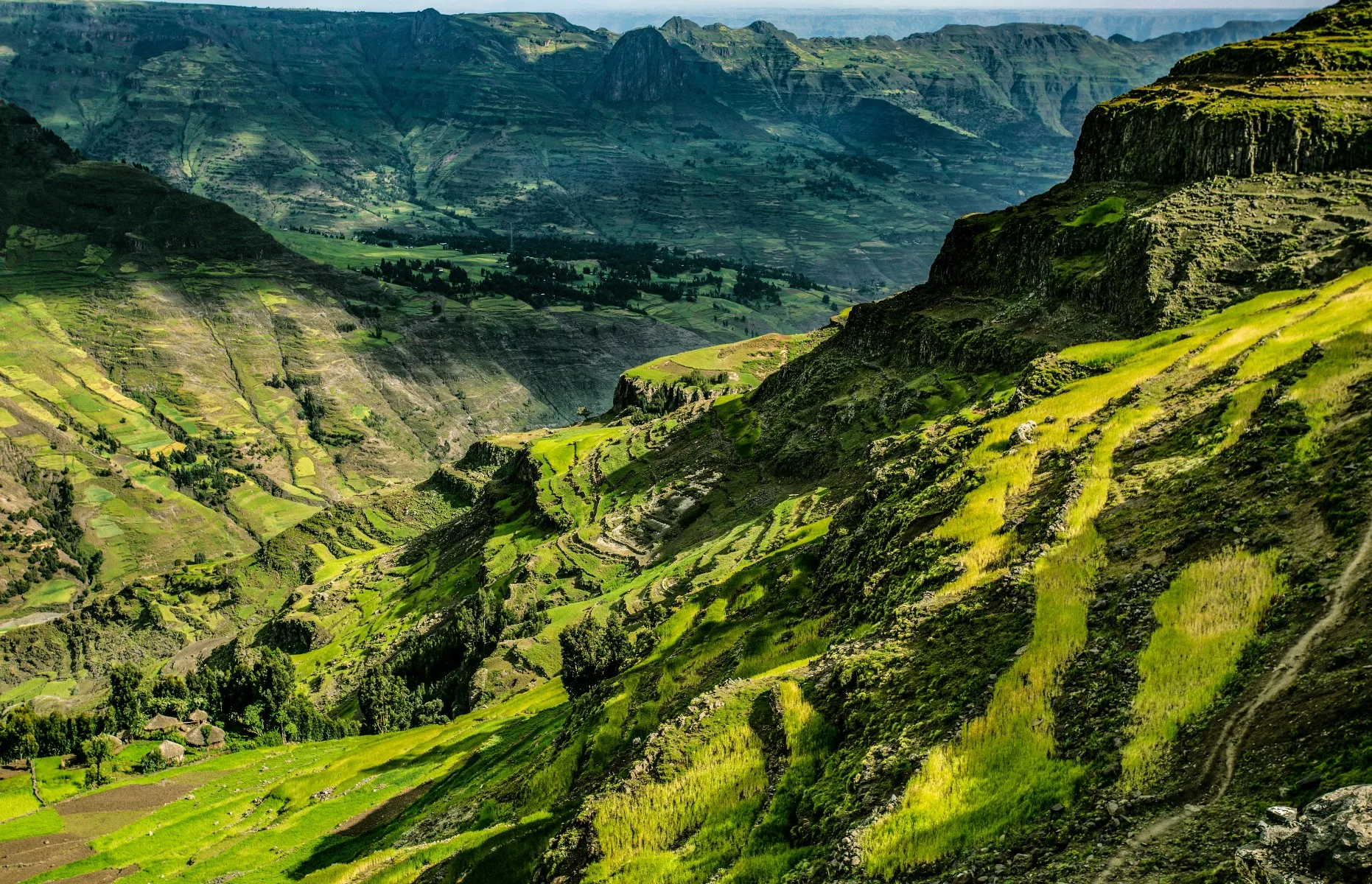
Ethiopia cannot be understood through one monument, one landscape or one itinerary. Its northern highlands preserve rock-hewn churches, castles, monasteries and ancient urban traditions. The east opens into the living lanes of Harar. The southeast rises into the Afro-alpine plateaus and forests of Bale before descending toward Sof Omar. Farther south and southwest, the Rift Valley, Chebera Churchura, the Lower Omo and Borana reveal very different ecosystems and cultural landscapes.
The result is not a destination to rush. Ethiopia is large, roads can be demanding, domestic connections may change, and access to particular regions can shift at short notice. A professional journey therefore begins with a qualified local operator, current official travel advice and a willingness to revise the route when conditions require it.
This guide presents Ethiopia as a collection of complementary travel regions. It is designed to help travelers understand what can be combined—not to promise that every place will be accessible on every departure.
Addis Ababa: the practical and cultural starting point
Most international journeys begin in Addis Ababa. The capital is more than a transit stop: it provides essential context before entering the country’s historic, natural and cultural landscapes.
A well-paced stay may include the National Museum, the Ethnological Museum when open, Entoto’s highland viewpoints, established galleries, traditional and contemporary food, and carefully chosen markets. Opening hours, museum displays and traffic conditions should be checked locally rather than assumed.
Addis is also the place to confirm domestic flights, road conditions, park permits, guide arrangements and any itinerary changes. Travelers attempting a multi-region journey should keep at least one flexible night in the capital between major route segments.
The Historic North: Lake Tana, Gondar, Simien, Aksum and Lalibela
Northern Ethiopia contains several of the country’s best-known heritage landscapes, but each deserves time in its own right.
Bahir Dar and Lake Tana
Bahir Dar is a base for exploring Lake Tana and selected island or peninsula monasteries. Visits should be arranged with licensed boat operators and should respect individual religious-site rules, including dress requirements and any access restrictions. The Blue Nile Falls may also be considered when local water levels, road conditions and site access make the excursion worthwhile.
Gondar
Gondar’s royal compound, churches and layered urban history make it a natural companion to Lake Tana. A local guide can place the architecture within the wider political and religious history of the Ethiopian highlands rather than presenting the castles as isolated monuments.
Simien Mountains
The Simien Mountains introduce a dramatic high-altitude landscape of escarpments, valleys and endemic wildlife habitat. Routes range from viewpoint visits to multi-day trekking. Altitude, cold nights, trail conditions and park procedures require realistic preparation. Wildlife encounters are never guaranteed, and travelers should keep a safe distance from all animals.
Aksum and the Tigray heritage extension
Aksum is central to understanding Ethiopia’s ancient history. Archaeological areas, stelae, museums and living religious traditions require careful interpretation and respectful behavior. A wider Tigray or Gheralta extension should be offered only after current security, road access, site opening and community readiness have been verified immediately before travel.
Lalibela
Lalibela’s rock-hewn churches remain active places of worship, not simply architectural attractions. Visitors should follow clergy and guide instructions, dress modestly, avoid interrupting services and ask before photographing worshippers. Festival periods can be deeply meaningful but require early planning and sensitive crowd management.
Access across northern Ethiopia can change quickly. A published itinerary must never guarantee an overland circuit or a specific site visit until a qualified operator has reconfirmed security conditions, transport, opening arrangements and official advice for the exact travel dates.
Afar and the Danakil: a specialist expedition only
Erta Ale and the Danakil Depression belong in a complete account of Ethiopia, but they should never be treated as a casual add-on. Extreme heat, volcanic terrain, long drives, limited services and changing regional conditions demand specialist planning.
Travel should proceed only when the route is open, official advice permits it and an experienced operator has confirmed vehicles, communications, water, guides, permissions, emergency procedures and realistic evacuation options. Volcanic activity and lava visibility change naturally; neither should be guaranteed in marketing.
Eastern Ethiopia: Dire Dawa, Harar and Awash
Harar Jugol is a living fortified town shaped by Islamic, African and trading traditions. Its gates, lanes, markets, homes and places of worship are best explored with a knowledgeable local guide. Visitors should ask before photographing people, respect prayer times and remember that homes and religious spaces are not stage sets.
Dire Dawa may serve as the transport gateway to the east and can add its own railway-era and market history when time and access allow. Awash National Park can form a separate nature extension from Addis or the eastern route, but heat, road conditions, park access and wildlife movements should be confirmed locally.
Bale Mountains and Sof Omar
Bale Mountains National Park protects an exceptional transition from high grasslands and Afro-alpine plateaus to montane forest. A responsible visit may combine Dinsho, the Sanetti Plateau and the Harenna Forest, depending on weather, road conditions and park guidance.
The landscape offers possibilities for walking, birding and observing endemic wildlife, but sightings must never be promised. High elevation also requires warm clothing, sun protection, hydration and a measured pace.
Sof Omar is both a natural formation and a place with religious and cultural meaning. It should be visited only with current access confirmation and suitable local guidance. Travelers need secure footwear and must respect instructions concerning water, darkness, slippery surfaces, sacred areas and seasonal conditions. Avoid unsupported superlatives about the cave’s size; its atmosphere and heritage are compelling without exaggeration.
The Rift Valley and southern gateway
The Ethiopian Rift contains lakes, wetlands, agricultural landscapes and towns that can break the long journey south. The exact sequence should be chosen for current road conditions and the traveler’s interests rather than simply collecting stops.
Arba Minch is often used as a base for the southern highlands and lakes. Nearby community visits must be locally led, fairly paid and based on consent. Konso’s terraced cultural landscape can add important perspective on land management, architecture and community history when access is confirmed.
The Gedeo cultural landscape and other southern areas can be considered as separate extensions. They should not be squeezed into an already demanding circuit merely to increase the destination count.
Chebera Churchura National Park
Chebera Churchura protects a mosaic of forest, grassland, river and wetland habitat in southwest Ethiopia. It can appeal to travelers seeking a less conventional protected-area experience, but it requires more preparation than a mainstream safari circuit.
Road time, seasonal access, accommodation standards, park permissions, ranger arrangements and communications should all be confirmed before sale. Elephants and other wildlife occur in the wider ecosystem, but sightings depend on season, movement and field conditions. The park should be marketed for its landscape and conservation value rather than as a guaranteed checklist.
South Omo: people first, photographs second
South Omo is too often marketed through simplified images of “tribes.” A responsible journey instead recognizes distinct communities, languages, livelihoods and personal choices. Visits should be arranged through accountable local partners and should never turn daily life into a performance for visitors.
Travelers should know who receives payment, what the visit involves and whether photography is welcome. Consent must be requested for every portrait. A fee does not erase a person’s right to decline, and children should not be encouraged to pose or miss school for visitors.
Jinka may serve as a logistical base for selected community-led visits and for Mago National Park when conditions permit. The Lower Valley of the Omo also has major archaeological importance, but UNESCO World Heritage status should not be confused with automatic tourist access to every research location.
Borana National Park and the Yabelo area
Borana National Park—also written Borena National Park—and the wider Yabelo area extend the journey into southern Oromia. Borana National Park and Yabelo Wildlife Sanctuary are distinct protected areas, so itineraries must name the intended place accurately and confirm the relevant permissions.
This region is best approached through local expertise in roads, water, wildlife, pastoral livelihoods and community protocols. The experience may combine open landscapes, birding, conservation interpretation and locally agreed cultural encounters. It should not be sold as a guaranteed large-animal safari.
A realistic modular Ethiopia journey
This sample is a planning framework, not a fixed package. Ethiopia’s size and changing access make a modular itinerary more professional than promising one uninterrupted road circuit. Domestic flights, rest nights and alternative routing should be confirmed by the operating company.
- Days 1–2 — Addis Ababa:
Arrive, rest, gain cultural context and reconfirm every following route segment.
- Days 3–4 — Bahir Dar and Lake Tana:
Explore selected heritage sites with licensed boat and local guide arrangements.
- Day 5 — Gondar:
Visit the royal and religious heritage of the city with time for interpretation.
- Days 6–7 — Simien Mountains:
Choose a viewpoint or trekking program suited to fitness, altitude and current access.
- Days 8–9 — Aksum or Lalibela:
Use a confirmed domestic connection; add only the site that is operationally realistic, or extend the journey to include both.
- Days 10–11 — Harar and Dire Dawa:
Explore the living historic city respectfully and use Dire Dawa as the eastern gateway where appropriate.
- Days 12–15 — Bale Mountains and Sof Omar:
Allow time for altitude, changing ecosystems, road conditions and a guided cave visit when open.
- Day 16 — Addis Ababa reset:
Build in a buffer night before beginning the southern or southwestern module.
- Days 17–19 — Chebera Churchura:
Travel with confirmed park, ranger, vehicle and accommodation arrangements.
- Days 20–23 — Arba Minch, Konso and South Omo:
Keep community encounters consent-based and avoid an exhausting checklist itinerary.
- Days 24–25 — Borana and Yabelo:
Confirm whether the program visits Borana National Park, Yabelo Wildlife Sanctuary or community landscapes.
- Day 26 — Return connection:
Allow a protected buffer before the international departure.
Afar and Erta Ale, the Gheralta churches, Awash, Gambella and additional Rift Valley or coffee-region stays are best added as separate modules. Adding destinations without adding time weakens safety, interpretation and local benefit.
When to travel
There is no single perfect month for every part of Ethiopia. Elevation creates major differences in temperature and rainfall, while road access, festivals, wildlife movement and regional conditions may affect the final plan.
Rather than publishing one country-wide “best season,” operators should give date-specific guidance for each route segment. Travelers should pack for both strong sun and cold highland conditions, and should expect plans to change when rain or road conditions make a transfer unsafe.
Responsible travel standards
Use licensed, locally accountable operators and appropriately qualified guides.
Check official travel advice and local operational information immediately before each region.
Ask permission before photographing any person, ceremony, home or place of worship.
Do not distribute sweets, money or gifts directly to children.
Use transparent community fees and ask how local hosts benefit.
Follow park rules, remain on authorized routes and never pressure guides to approach wildlife.
Carry water responsibly and avoid unnecessary single-use plastic where safe alternatives exist.
Do not remove stones, plants, archaeological material or cultural objects.
Allow buffer days instead of asking drivers to compensate for delays with unsafe speed.
Respect temporary closures and route changes without pressuring an operator to proceed.
Frequently asked questions
Can I see all of Ethiopia in one trip?
No. A country-wide introduction requires several weeks and still involves choices. A modular journey with internal connections and rest days is more realistic than one continuous road loop.
How long should I allow?
Around two weeks can introduce one or two regions. Three to four weeks allows a broader journey, while the 26-day framework above still requires current access and carefully managed transfers.
Can the Historic North and South Omo be combined?
Yes, when both regions are accessible and domestic connections operate, but the itinerary needs buffer time. It is usually better to fly back through Addis than to force an uninterrupted overland route.
Are wildlife sightings guaranteed?
No. Bale, Simien, Chebera Churchura, Mago, Borana and other protected areas are natural ecosystems. Weather, season, habitat and animal movement all affect sightings.
Is South Omo appropriate for cultural tourism?
It can be, when visits are community-led, consent-based and economically transparent. Travelers should reject programs built around intrusive photography, staged stereotypes or treating people as attractions.
Is Ethiopia currently safe to visit?
Conditions differ by region and may change quickly. Travelers must consult their government’s current advice, obtain suitable insurance and use an operator who will cancel or reroute a program when conditions require it. A blog article cannot replace live security assessment.
Plan Ethiopia with time, humility and flexibility
Ethiopia’s strength is not that every destination fits neatly into one circuit. It is that each region changes the traveler’s understanding of the country: the northern highlands reveal long histories of faith and statehood; Harar introduces a distinct eastern urban tradition; Bale moves from high plateau to forest; Sof Omar adds natural and spiritual depth; Chebera Churchura opens a less-traveled conservation landscape; and South Omo and Borana demand careful, respectful engagement with living communities.
The professional way to travel is to choose fewer places, stay longer and let current conditions determine the route. With honest planning and strong local partnerships, Ethiopia becomes more than a list of famous sites—it becomes a journey through landscapes and communities that deserve attention on their own terms.
Plan Your Journey with Verified Local Operators
Ethical itineraries · Registered local guides · Direct booking
TravelAfricas Editorial Team
Our editorial team collaborates with licensed local guides, conservationists, and regional travel specialists to produce accurate, responsible African travel dispatches.