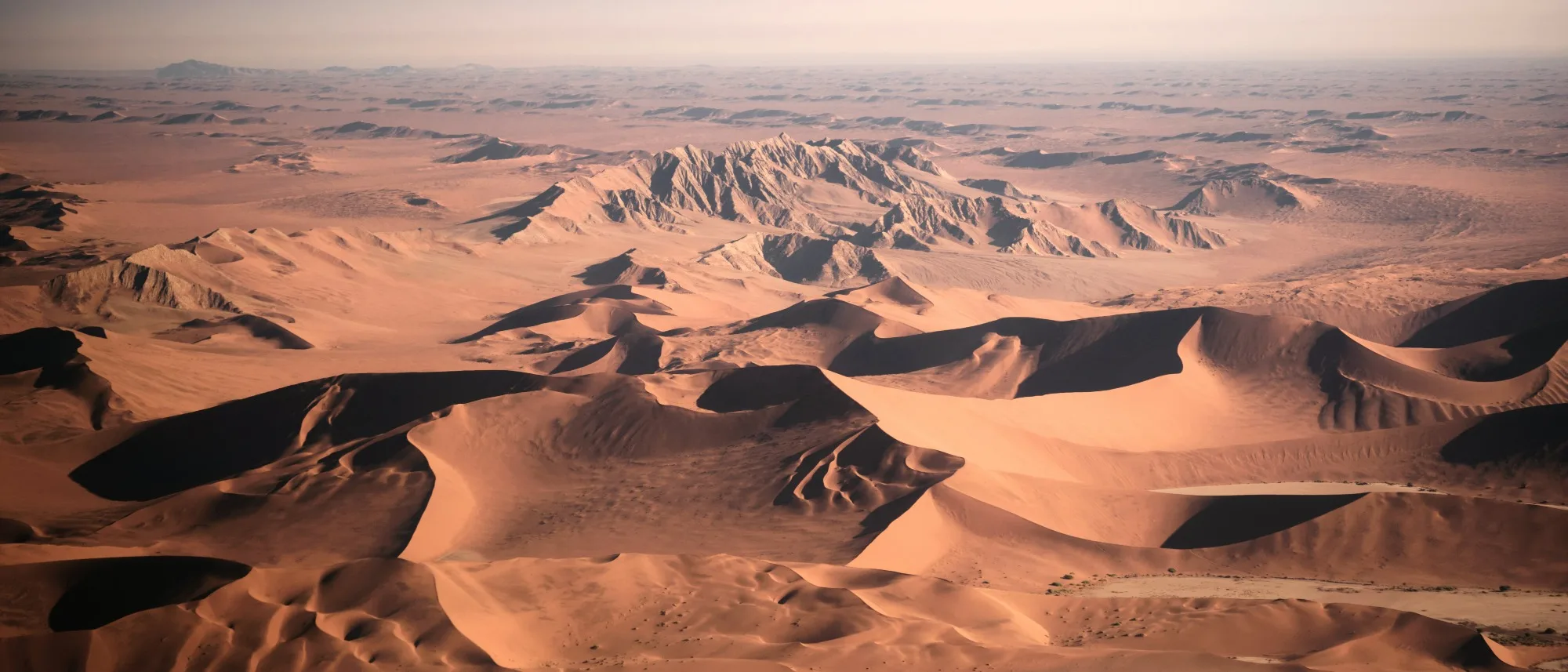
Namibia is a country measured in horizons. Roads cross plains that appear to have no edge. Dunes rise like walls from the desert floor. Along the Atlantic coast, fog drifts inland over sand that may not have seen meaningful rainfall for years. Farther north, wildlife gathers around waterholes in one of Africa’s most distinctive safari landscapes.
It is tempting to describe Namibia only through superlatives: immense, ancient, silent, otherworldly. Yet the country becomes more interesting when those impressions are connected. The dunes, coast, rock art and wildlife are not isolated attractions. Together, they tell a story about adaptation—to aridity, distance, changing climate and the demands of life in a beautiful but exacting environment.
A journey from Sossusvlei to Etosha is one of the clearest ways to experience that story. It can combine the Namib Sand Sea, the Atlantic character of Swakopmund, the cultural landscape of Damaraland, the rock engravings of Twyfelfontein and the wildlife of Etosha National Park. The route requires time, careful logistics and respect for long distances, but it reveals far more than Namibia’s famous dunes.
Why Namibia feels unlike anywhere else
Namibia’s drama comes from space. Even established travel routes pass through long sections of sparsely populated country. The journey between destinations is therefore part of the experience rather than an inconvenience between highlights.
The landscape changes gradually: central highlands give way to gravel plains, mountains dissolve into desert, and dry riverbeds support ribbons of vegetation where animals may travel. Near the coast, the meeting of cold Atlantic air and desert heat creates fog that sustains highly specialized life.
This relationship is especially visible in the Namib Sand Sea. UNESCO describes it as the world’s only coastal desert with extensive dune fields influenced by fog. Its dunes, gravel plains, coastal flats and ephemeral rivers support species adapted to one of the planet’s most arid environments.
Namibia also carries deep human histories. Rock engravings at Twyfelfontein record generations of observation and meaning. Contemporary communities continue to shape conservation, tourism and cultural life. A thoughtful itinerary makes room for those stories instead of presenting the country as empty wilderness.
Windhoek: beginning with context
Most journeys begin in Windhoek, Namibia’s capital and practical transport hub. The city is useful for more than collecting a vehicle or connecting to a domestic flight. It offers a gentler introduction to the country’s history, architecture and contemporary identity.
Spend time understanding the route ahead. Confirm fuel stops, road conditions, park reservations and emergency contacts. If traveling with an operator, this is the moment for a full briefing about driving distances, accommodation standards, wildlife etiquette and what is included.
Windhoek also gives travelers time to recover after an international flight. Beginning a long gravel-road journey immediately after arrival increases fatigue and leaves little room for delayed luggage or disrupted connections. One unhurried night can make the expedition safer and more enjoyable.
Sossusvlei and Deadvlei: landscapes shaped by wind
Southwest of Windhoek, the road enters increasingly open country on the way toward Sesriem and the Sossusvlei area. The final approach reveals the scale of the Namib: red-orange dunes, pale pans and mountains sharpened by dry air.
Sossusvlei is often photographed at sunrise, when low light creates a strong contrast between illuminated slopes and deep shadow. Nearby Deadvlei is known for dark, long-dead camel-thorn trees standing against a white clay pan and surrounding dunes. The scene is visually powerful, but it should be approached as a sensitive desert environment rather than a photography set.
Start early, follow park regulations and carry more water than you expect to need. Sand temperatures and direct sun can become severe. Walk at a pace that allows you to notice smaller details: wind patterns on dune faces, tracks crossing the sand and plants surviving where moisture appears almost absent.
Climbing a dune is optional. The experience is not diminished by remaining on established routes or choosing a shorter walk. Desert travel rewards attention more than endurance.
The living Namib Sand Sea
The Namib may appear empty at first glance, but its ecological story is one of specialization. Fog can be a critical source of moisture, supporting organisms that have developed unusual strategies for collecting or conserving water.
UNESCO recognizes the Namib Sand Sea not only for its beauty but also for its geological and ecological processes. Shifting dunes, ancient underlying formations and changing atmospheric conditions create many microhabitats across an enormous protected landscape.
Travelers can help protect that integrity by remaining on authorized tracks, avoiding disturbance to plants and animal burrows, and never removing stones, seeds or other natural material. Off-road driving may leave marks that persist far longer than expected in arid terrain.
Night can be as memorable as day. With minimal light pollution in many areas, the sky becomes part of the landscape. Stargazing should still be organized safely: stay near camp, carry a light and remember that temperatures can fall sharply after sunset.
Swakopmund: where desert meets Atlantic air
The journey north toward Swakopmund exchanges red dunes and interior heat for coastal fog and cooler air. The town’s architecture, restaurants and walkable centre provide a striking change of pace after several days in the desert.
Swakopmund can be treated as a rest stop, but it also offers a base for learning about the coastal environment. Excursions may explore dunes, marine life or the wider coast, depending on weather and local regulations. Nearby Walvis Bay is known for its lagoon and birdlife, while the surrounding landscapes demonstrate how closely ocean and desert systems interact.
Choose activities carefully. Motorized adventures should use authorized zones and responsible providers. Wildlife encounters must maintain appropriate distance and avoid feeding, touching or crowding animals. A quieter guided nature experience can reveal more about desert adaptation than a fast crossing of the dunes.
Allow time simply to slow down. Dusty equipment can be cleaned, laundry handled and travel plans reconfirmed before continuing into more remote regions.
Damaraland: geology, wildlife and living communities
North of the coast, the landscape opens again into plains, rocky outcrops and dry river valleys. The broad region commonly called Damaraland is not a single attraction but a cultural and geographical area with striking formations and community lands.
Wildlife can move through these arid spaces, but sightings should never be guaranteed. Desert-adapted elephants and other animals range across large territories according to water, vegetation and human activity. Tracking must be undertaken with experienced guides who understand animal behaviour and local access rules.
Community-based tourism is particularly important here. Conservancies and locally connected enterprises can help align tourism income with conservation and livelihoods. Ask an operator how local guides, accommodation staff and community partners participate in the itinerary—not only how many wildlife sightings are expected.
Respect applies equally to villages and landscapes. Request permission before photographing people, avoid distributing gifts directly to children and purchase crafts through transparent, locally beneficial channels.
Twyfelfontein: reading an ancient cultural landscape
Twyfelfontein, also known as /Ui-//aes, contains one of Africa’s largest concentrations of rock engravings. UNESCO reports more than 2,000 documented figures, including animals, human and animal footprints, and images associated with Late Stone Age communities.
The site deserves time and interpretation. A qualified guide can help explain what researchers understand, what remains uncertain and how the engravings relate to the surrounding landscape. Avoid reducing the visit to a quick photograph of a single panel.
Do not touch, trace, wet or mark the rock surfaces. Even well-intentioned contact can contribute to deterioration. Remain on designated paths and follow the instructions of site guides.
The most meaningful visit recognizes that rock art is not simply decoration from a vanished world. It forms part of a continuing African cultural inheritance that requires protection, humility and careful interpretation.
Etosha: wildlife around the waterholes
Etosha National Park introduces another transformation. At its centre lies an immense salt pan, while surrounding grasslands, woodland and waterholes support a wide range of wildlife. During drier periods, animals may concentrate near available water, creating patient and sometimes dramatic viewing opportunities.
Etosha is Namibia’s flagship wildlife destination, but it is not a controlled performance. A waterhole can be busy one hour and quiet the next. The best approach is to slow down, scan carefully and let animal behaviour determine the rhythm of the day.
Follow park speed limits and never leave a vehicle where doing so is prohibited. Do not block an animal’s route to water, pressure a sighting for a better camera angle or allow food to attract wildlife. Quiet observation usually produces a richer experience and reduces stress on animals.
Binoculars are often more valuable than a powerful camera. They encourage travelers to notice interactions: birds responding to a predator, antelope approaching water cautiously or elephants negotiating space as a group.
When to visit Namibia
Namibia can be visited in different seasons, but the experience changes.
May to October: Generally cooler and drier, with cold mornings possible. Wildlife viewing in Etosha is often associated with animals gathering around water sources. This is also a popular travel period, so early reservations are advisable.
November to April: Warmer conditions, occasional rain and dramatic skies can transform parts of the landscape. Birdlife and new vegetation may be rewarding, while heat and localized road conditions require flexibility.
Seasonal descriptions are only a starting point. Conditions vary from year to year, and climate patterns do not follow a perfect calendar. Confirm current temperatures, road access and park information shortly before traveling.
Guided journey or self-drive?
Namibia is widely associated with self-drive travel, but independence should not be confused with simplicity. Distances are long, many roads are gravel, mobile coverage may be limited and fuel stations can be widely separated.
A self-drive journey may suit travelers with relevant experience who are comfortable with route planning, tyre changes, conservative gravel-road driving and emergency preparation. Rental restrictions and insurance conditions must be understood before departure.
A guided tour can reduce logistical pressure and add local interpretation. An experienced guide manages navigation, park procedures, wildlife observation and the practical rhythm of long travel days. Guided travel may be particularly valuable for first-time visitors, families, photographers or anyone who prefers to focus on the landscape rather than the road.
Whichever model you choose, avoid schedules that turn every day into a race. Namibia looks manageable on a map, but distance, road surface and photo stops change real travel times.
A balanced 10-day Namibia route
This sample route is a planning framework rather than a fixed package. Exact accommodation and driving stages should be confirmed with a qualified Namibian operator.
- Day 1 — Windhoek:
Arrive, rest and receive a complete route and safety briefing.
- Day 2 — Windhoek to the Sossusvlei region:
Travel through changing highland and desert scenery; arrive before dark.
- Day 3 — Sossusvlei and Deadvlei:
Begin early for cooler temperatures and softer light; explore at a responsible pace.
- Day 4 — Namib to Swakopmund:
Cross the desert toward the Atlantic coast, allowing sufficient time for road conditions.
- Day 5 — Swakopmund and Walvis Bay:
Choose a responsible coastal, marine or desert activity and leave time to rest.
- Day 6 — Swakopmund to Damaraland:
Enter rocky, increasingly remote landscapes with scenic stops along the way.
- Day 7 — Twyfelfontein and Damaraland:
Visit the rock-art landscape with a qualified guide; support community-linked tourism where possible.
- Day 8 — Damaraland to Etosha:
Travel toward the national park and begin wildlife viewing if time and gate hours permit.
- Day 9 — Etosha National Park:
Spend a full day observing wildlife patiently around different habitats and waterholes.
- Day 10 — Etosha to Windhoek or onward connection:
Return without compressing the schedule around an inflexible same-day international departure.
Adding two or three nights will make this journey more comfortable. Extra time can be used in Etosha, Damaraland or the desert rather than adding more destinations.
Responsible travel across Namibia
Responsible travel in Namibia begins with recognizing scarcity. Water, fuel, shade and emergency support cannot be assumed everywhere.
Refill reusable bottles where safe water is available and follow lodge guidance on conservation.
Keep speed low on gravel roads and reduce dust near people, livestock and wildlife.
Carry waste out of remote areas and avoid single-use items when practical.
Remain on authorized roads and tracks.
Give wildlife space and never feed animals.
Choose locally connected guides, conservancies and accommodations.
Obtain permission before photographing people or private property.
Treat rock art and archaeological material as protected heritage.
Ask operators direct questions about group size, guide employment, waste practices and community partnerships. Responsible claims should be supported by clear operational choices.
Practical planning before departure
Entry requirements depend on nationality, purpose of travel and transit route. Verify the latest rules through official Namibian authorities and your travel provider before purchasing non-refundable services. Passport-validity and blank-page requirements can apply, and travelers transiting through another country must also meet that country’s rules.
Comprehensive insurance should cover medical treatment, evacuation, cancellation and the activities included in the itinerary. Self-drive travelers should confirm insurance exclusions for tyres, windscreens, gravel roads, underbody damage and driving after dark.
Carry essential medication and do not assume that a remote lodge can replace it. Discuss vaccinations and personal health needs with an appropriate medical professional well before travel.
Finally, share the route with someone outside the traveling party. Confirm emergency procedures with the operator or rental company and build enough time into the itinerary to respond safely to weather, vehicle problems or road delays.
Frequently asked questions
Is ten days enough for Namibia?
Ten days can connect Sossusvlei, Swakopmund, Damaraland and Etosha, but the pace will be active. Twelve to fourteen days provides more rest and longer stays.
Can I combine the desert and a wildlife safari?
Yes. The route between Sossusvlei and Etosha is popular precisely because it combines contrasting environments. The distances require realistic planning.
Do I need a four-wheel-drive vehicle?
Vehicle requirements depend on the final route, season and accommodation access. Do not assume that every scenic detour is suitable for a standard vehicle. Follow current advice from the rental company or operator.
Is Namibia suitable for families?
It can be, but long drives, heat and early starts should be considered carefully. A slower itinerary with appropriate rooms, meal arrangements and regular breaks is preferable.
Can wildlife sightings be guaranteed in Etosha?
No. Wildlife moves freely, and responsible operators do not guarantee particular species. Season, water availability, patience and chance all influence sightings.
Let Namibia unfold slowly
Namibia is not a destination to collect quickly. Its meaning emerges through scale: the distance between water sources, the time recorded in stone, the movement of fog across dunes and the silence before animals approach a waterhole.
From Sossusvlei to Etosha, each landscape changes the way the next one is understood. The desert makes the coast feel improbable. Ancient engravings deepen the human story. Etosha reveals how life organizes itself around scarcity.
TravelAfricas connects travelers with African specialists who can build routes around real conditions, responsible pacing and local knowledge. Until a verified Namibia package is available on the marketplace, use the platform to explore destinations or request a custom journey.
Travel farther than the postcard. Give Namibia the time it deserves.
Plan Your Journey with Verified Local Operators
Ethical itineraries · Registered local guides · Direct booking
TravelAfricas Editorial Team
Our editorial team collaborates with licensed local guides, conservationists, and regional travel specialists to produce accurate, responsible African travel dispatches.