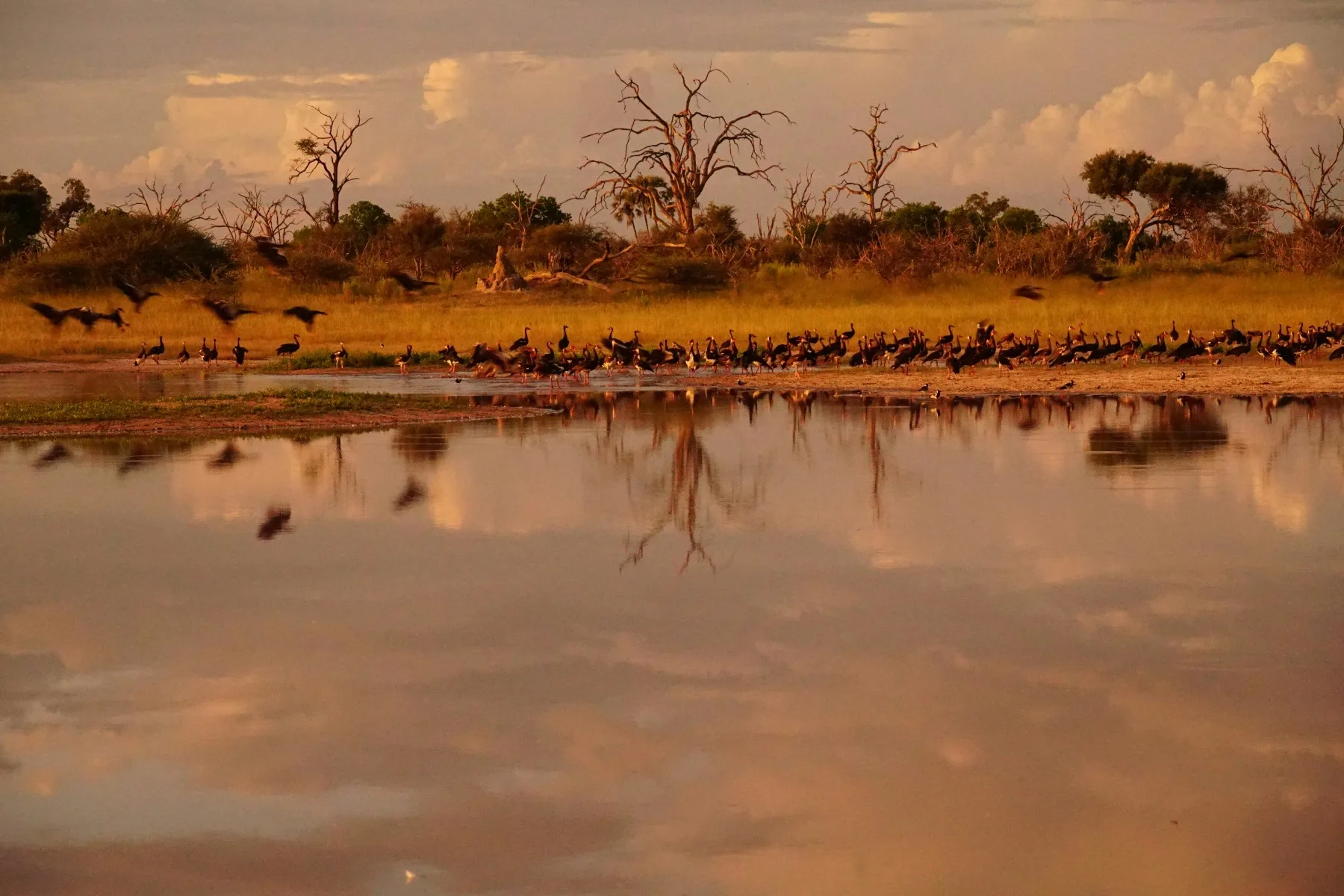
The Okavango Delta is one of Africa’s most distinctive ecosystems: a wetland spreading into the Kalahari rather than flowing onward to the sea. Its channels and seasonally flooded plains deserve careful attention, but Botswana should not be reduced to one aerial photograph or one luxury camp.
The country’s northern landscapes also include the Chobe River, woodland and floodplain, the shifting environments of Savuti, the open Makgadikgadi salt pans and the gateway town of Maun. Water levels, rain, wildlife movement and road conditions change the character of each place.
A strong Botswana itinerary therefore depends on timing, route logic and an operator who explains what is possible without promising a fixed performance from nature.
Kasane and Chobe: begin with the river
Kasane is a practical northern gateway and a useful place to recover before safari. Nearby Chobe National Park is often associated with elephants, but the river system supports a broader web of wildlife, birds and seasonal movement.
Boat and vehicle activities reveal different aspects of the landscape. Operators must respect speed, distance, channel rules and the space needed by animals approaching water. Crowding a riverbank or blocking an elephant’s route is not responsible viewing.
Two nights allow travelers to experience changing light and activity rather than trying to complete both river and land viewing immediately after arrival.
Savuti and the interior: conditions define the route
Routes through the Chobe interior and toward Moremi can be highly seasonal. Deep sand, water, mud and wildlife movement affect driving times and access. This is not a place for optimistic map-based scheduling.
Mobile safaris and lodge combinations must be planned with suitable vehicles, experienced guides and clear contingency arrangements. Travelers should understand luggage limits, charging facilities, communication systems and what support is available if conditions interrupt the route.
The isolation is part of the experience, but it should never be romanticized at the expense of preparation.
Makgadikgadi: scale, silence and seasonal change
The Makgadikgadi landscape offers a strong contrast to the wetter north. Salt pans, grassland and enormous horizons can appear empty at first, yet their ecology changes with rain and season.
Activities must be presented honestly. Wildlife presence, pan conditions and road access vary. Quad-bike or vehicle experiences, where permitted, should follow authorized routes and avoid sensitive surfaces, nesting areas and wildlife.
Cultural encounters require the same care. Work only with programs that are community-led, accurately described and transparent about payments. People are not an attraction staged for visitors.
Maun: more than a transit lounge
Maun is the principal gateway for many Delta journeys, but it is also a living town. Build time for supply checks, luggage reorganization and a complete briefing before a light-aircraft or road transfer.
Small aircraft impose strict baggage and weight limitations that must be communicated before travel. Weather and operational conditions can alter schedules. Connections should include a sensible buffer rather than depending on a perfect chain of flights.
Locally guided cultural, craft or food experiences can add context when time permits and benefits are clear.
The Okavango Delta: water does not follow a simple calendar
UNESCO describes the Okavango as a major inland delta with permanent marshes and seasonally flooded plains. The annual flood interacts with local rainfall in complex ways, so “wet season” and “high water” are not interchangeable labels.
Mokoro, boating and vehicle activities depend on the camp location, current water level and safety conditions. A photograph from one part of the Delta cannot guarantee what another concession will look like at the same time.
Ask the operator which activities are normally possible at the selected camp during the proposed dates and what alternatives exist if water is too low or conditions change.
Walking and water activities require strict attention to guide instructions. Remain seated when directed, keep limbs inside the craft, avoid sudden movement and never approach wildlife independently.
Tourism value and local participation
Botswana’s safari model is often described through exclusivity and low visitor density. Travelers should still ask practical questions: Who owns the operation? How are guides trained and employed? Which supplies are sourced locally? How do nearby communities participate in decision-making and benefit from tourism?
Price alone does not prove sustainability. Credible operators should be able to explain conservation fees, employment practices, waste systems and community relationships without relying on vague claims.
A balanced 10-day Botswana route
This sample route is a framework rather than a fixed package. Seasonal water, road access, flight schedules and camp operations must be confirmed for the specific travel dates.
Botswana routes often combine road transfers and light aircraft. The final sequence should be designed around current access and confirmed connections, not copied from a generic map.
- Day 1 — Kasane:
Arrive, rest and complete a detailed safari, luggage and safety briefing.
- Day 2 — Chobe River region:
Combine responsibly operated land or water viewing without crowding animals at the river.
- Day 3 — Chobe:
Use a second day to observe changing habitats and avoid chasing a guaranteed species list.
- Day 4 — Chobe to Makgadikgadi region:
Travel by the confirmed route with realistic transfer time and planned stops.
- Day 5 — Makgadikgadi:
Explore the pan environment according to current surface, weather and wildlife conditions.
- Day 6 — Makgadikgadi and surrounding communities:
Choose a credible locally led experience or a second landscape activity without forcing the schedule.
- Day 7 — Makgadikgadi to Maun:
Transfer, reorganize luggage and confirm the next air or road movement.
- Day 8 — Okavango Delta:
Enter the Delta by the confirmed connection and follow all guide instructions around water and wildlife.
- Day 9 — Okavango Delta:
Select activities suited to current water levels rather than expecting every camp to offer the same experience.
- Day 10 — Delta to Maun or onward connection:
Return with a realistic buffer for weather or operational delays.
With two additional nights, add time in the Delta or include a carefully routed Moremi or Savuti sector. Do not compress another remote reserve into the existing ten days.
When to consider traveling
Botswana’s seasons affect water, temperature, vegetation, road access and wildlife distribution. The Okavango flood may arrive months after rain falls farther north, while local rain creates its own changes across the Kalahari.
Hot periods can be intense, and nights may be cold in the dry season. Ask about the exact camp locations, expected water conditions, vehicle access and activity mix for the proposed dates. Avoid marketing any month as a guarantee.
Responsible safari choices
Follow guide instructions during vehicle, walking and water activities.
Never ask a guide to crowd, chase or block wildlife.
Keep noise low and remain seated when instructed.
Respect baggage limits and safety procedures on light aircraft.
Carry waste out of remote areas and minimize single-use packaging.
Use water sparingly and ask camps how waste and sewage are managed.
Obtain permission before photographing people or private property.
Choose community-led experiences with transparent payments.
Ask operators to explain conservation contributions and local employment.
Treat water levels and wildlife sightings as variable, never guaranteed.
Frequently asked questions
Is the Okavango Delta flooded all year?
No. The Delta includes permanent and seasonal water, and conditions vary by location and month. Confirm the likely activity mix with the selected camp or operator.
Can I drive between all the destinations myself?
Some routes require advanced four-wheel-drive experience and seasonal knowledge; others are commonly connected by light aircraft. Travelers should not assume that a visible map route is currently passable.
Are elephants guaranteed in Chobe?
Chobe is well known for elephants, but no ethical operator should guarantee a wildlife encounter. Distribution changes with water, season and disturbance.
Is Botswana only for luxury travelers?
Botswana includes high-cost remote camps, but mobile safaris and different accommodation categories may provide alternatives. Compare what is included, transport logistics and conservation fees rather than judging only the headline price.
How many nights should I spend in the Delta?
Three nights is a useful minimum for many travelers. Additional time or a second camp can reveal different habitats, but transfers and budget must be considered carefully.
Let changing conditions shape the safari
Botswana’s most rewarding journeys do not force the landscape to match a brochure. River levels change, pans fill and dry, animals move, and access routes respond to weather.
Choose an operator who communicates those uncertainties clearly. With enough time and realistic expectations, the contrast between Chobe, Makgadikgadi and the Okavango becomes the story of the journey.
Plan Your Journey with Verified Local Operators
Ethical itineraries · Registered local guides · Direct booking
TravelAfricas Editorial Team
Our editorial team collaborates with licensed local guides, conservationists, and regional travel specialists to produce accurate, responsible African travel dispatches.